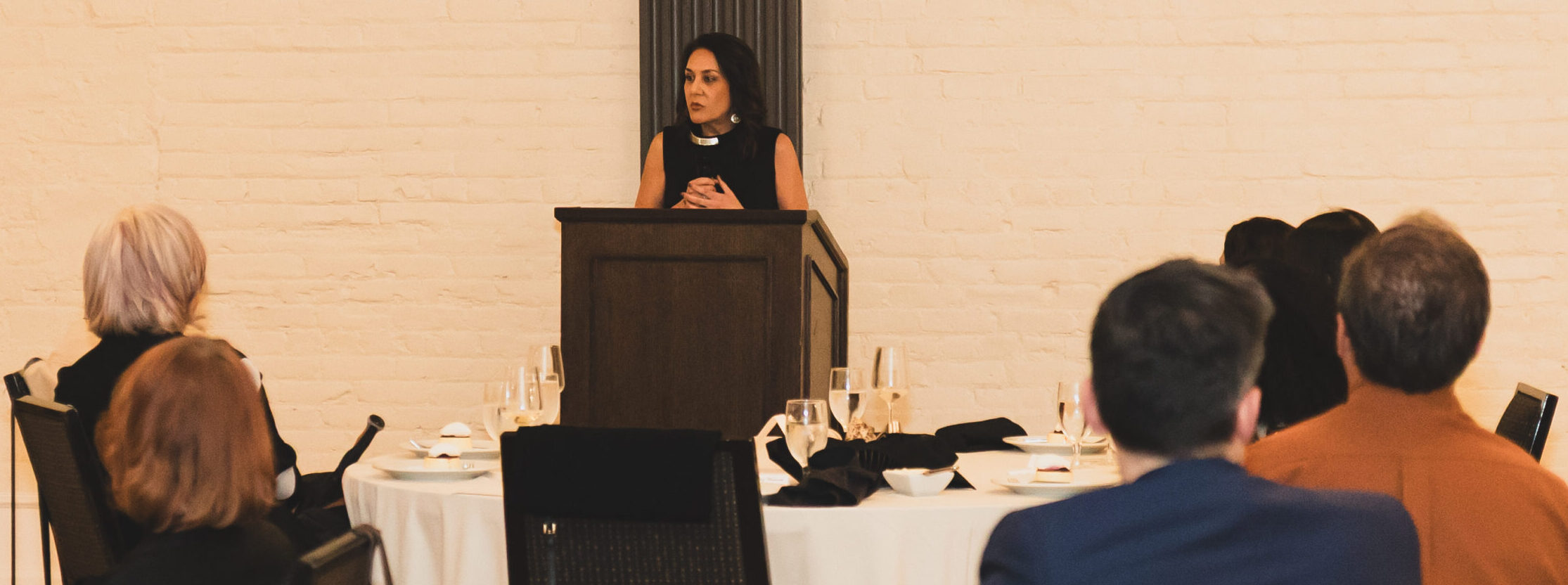
Good evening. Thank you, Tim. And congratulations to Public Media Company on 25 years.
I’m grateful to Tim Isgitt for bringing us together tonight, and to Susan Harmon, whose reflections we just heard and whose idea we are all here to honor. And I want to thank the PMC board and everyone in this room who has given so much of themselves to public media.
Tonight, we celebrate all that PMC has accomplished, and we look to the future of public media. So I want to begin with a question: If we were building public media today, for the people who live in our communities now, what would we build?
Hold that question in mind — I’ll come back to it before we’re done.
For so many of us, our relationship with public media began early. We sat cross-legged on the floor, a little too close to the television, and a big yellow bird taught us our letters. A count in a cape taught us numbers. And a soft-spoken man in a cardigan, who seemed to be talking only to us, showed us how to be a good neighbor. Generations of children have grown up just like this.
And public media grows with us, through education, culture, trusted news, and a connection to the place we call home. The voice from our parents’ kitchen becomes the voice in our own, in the morning and on the car ride home, and now the podcast in our earbuds on the walk to work.
Public media reaches 99% of the country, through more than 1,500 radio and television stations. But even that figure sells it short, because you can’t put a number on the curiosity of a child or on the connection of community members.
Today, too many Americans feel alone, divided and unsure what to believe. Against all of that, local public media is an antidote. It is among the last trusted sources of information — amplifying local voices and the emergency alerts people count on. It's the neighbor we lean on when the storm is near or the fire is close.
We don't have to second-guess; we don't need to wonder if the reporting is fact or fiction. We can simply trust. Today, that type of trust is a scarce resource. It takes decades to earn — and public media has earned it.
Our world will keep changing in unpredictable ways, and the way public media works will have to change with it. But why it exists will not: to educate, to inform, to inspire and to connect. And that hard-earned trust will be the foundation for everything to come.
At Knight Foundation, supporting public media is a priority for us. We understand what’s at stake. We have held to one belief for more than three-quarters of a century: informed communities are empowered communities. People who know what is happening where they live can do something about it.
Last year put that belief to the test. It was the hardest year in the history of public media. Federal funding was rescinded, and as many as 115 stations serving 43 million people faced closure. Most were in rural, Native, and underserved communities. The most essential stations were also the most dependent on federal dollars.
We could see the crisis coming, and we knew we had to move fast. Philanthropy had to move at the speed of news.
That is where you came in. Public Media Company had the experience, the station relationships, the data, and the legal structure to make grants and loans. You knew where the need would be greatest, and you made it possible to act quickly, with confidence. We weren’t starting from scratch. We were building on 25 years of your work.
In August 2025, six foundations came together, and Knight committed $10 million. By December, $26 million in grants had gone out to 74 organizations operating 186 stations and serving more than 30 million people.
Listeners gave in historic numbers, too. Other funders followed, and the Bridge Fund has now raised $87 million from more than 1,500 donors. Because of them, stations at risk of going silent still have a voice.
This was not an easy nor painless process. Stations made hard cuts to remain on the air. Those decisions fell to people who love this work, and they kept serving their communities through all of it. We are grateful to every one of them.
The Bridge Fund came together in months. PMC has spent 25 years building the relationships and expertise that made it possible. You have worked, project by project, with more than 450 nonprofit and noncommercial media organizations in all 50 states, D.C. and Puerto Rico.
That is how trust gets built, one station at a time. And it all started with a simple idea, championed by Susan Harmon and Marc Hand: that stations could be stronger together. Last year proved them right.
Emergency support gave stations room to breathe. Now comes the harder work of strengthening them to last. So tonight, I am pleased to announce the next phase of our partnership. With the full support of Knight’s board, we are committing another $10 million to the Bridge Fund over the next three years.
This support will help stations strengthen how they operate, sustain their operations while they do, and support the broader reinvention of public media.
It means that the news and information people rely on will still be there when their children grow up.
We believe deeply in the work and the vision of Public Media Company, and we are honored to be your partners as we build a more informed and connected future.
Which brings me back to my opening question: If we were building public media today, for the people who live in our communities now, including a generation that grew up with a phone in its hand, what would we build?
I said the relationship with public media begins early. That’s true for older generations. But for many young people in our communities, that relationship has never begun. They never sat on the living room floor watching Sesame Street.
I believe that each of them — that every member of our communities — deserves what the rest of us were given: something trustworthy and local that belongs to them.
Reaching the next generation will take new models, new sources of revenue, and new partners.
It will also take more than philanthropy. The Bridge Fund was never meant to fully replace the government funding we lost. It is a bridge to the future, and bridges are for crossing.
Philanthropy cannot, and should not, play this role permanently. What it did was buy us time. The question now is what we do with it. The years ahead will be the most consequential in public media’s history, as we move from answering a crisis to building for the long term.
Our job is not to preserve what public media was. It is to help it become what it needs to be. Together, we must prepare it to meet the future. So I have two asks tonight. To my fellow funders: stay past the emergency, and fund the reimagining. To station leaders: continue to experiment with new ideas and new ways of reaching the people you serve.
And none of us is going it alone. PMC is proof of what we can do together and so is the Bridge Fund.
Last year, many communities wondered whether their stations would have a future at all. Tonight, we get to ask a better question: How can public media thrive?
Americans value and trust their local public media stations. It’s on us to keep earning that trust for the next 25 years. So please raise a glass with me.
To Public Media Company: to 25 years, to the hundreds of organizations you have made stronger, and to the quarter century to come.
Thank you all.