By Evran Kavlak and Safwat Rahman | October 2026
Universities, school systems, and government bodies hold a meaningful share of the country's public broadcasting licenses. For decades, when one of these institutional licensees decided to exit, the default path was a sale, often to the highest bidder.
That path is changing.
Congress rescinded federal funding for the Corporation for Public Broadcasting in July 2025, and CPB officially went out of business in January. At the same time, station values are down, and cash buyers are scarce. For universities, school systems, and governments that have long subsidized their stations, the question is shifting from how to keep supporting a broadcast operation to how to hand it off responsibly. Increasingly, the answer is a transfer to a local nonprofit.
Recent examples include:
-
Penn State / WPSU (2026): Penn State transferred WPSU’s radio and TV licenses to WHYY, which completed the acquisition Oct. 1 after FCC approval in September. WPSU will keep its name and call letters, and donors provided working capital for the transition.
-
Lehigh University / WLVR (2026): Lehigh agreed to sell WLVR-FM to Lehigh Valley Public Media, which has managed the station since 2019, for $55,000 plus five years of underwriting credits. The sale, announced in June, is pending FCC approval.
-
UTEP / KTEP (2026): The University of Texas System Board of Regents approved an agreement for the El Paso Community Foundation to run KTEP-FM’s operations, programming, and fundraising, with an option to buy the station and its license for $1 million.
-
UMKC / KCUR (pending): The University of Missouri System’s Board of Curators backed a plan to transition Kansas City’s KCUR to a community-based, independent nonprofit within three years.
These deals are part of a broader pattern. Our analysis of more than 300 station license transactions involving institutional licensees since 2000 shows a clear shift: Since 2020, deals in which no cash changes hands at all have become the most common outcome. In this post, we walk through the numbers, the forces behind them, what we expect going forward, and what institutions weighing their options should keep in mind.
From Sales to Handoffs
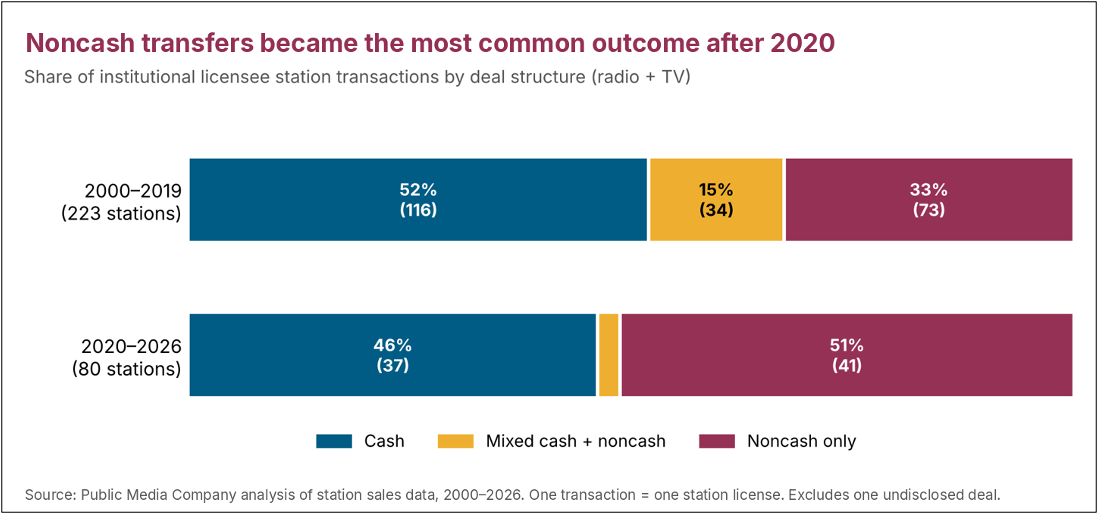
An analysis of how institutional licensee deals were structured – all-cash, a mix of cash and noncash considerations, or fully noncash – shows a real shift toward noncash transfers since 2020. Transfers with no cash at all rose from about a third of transactions before 2020 to just over half since.
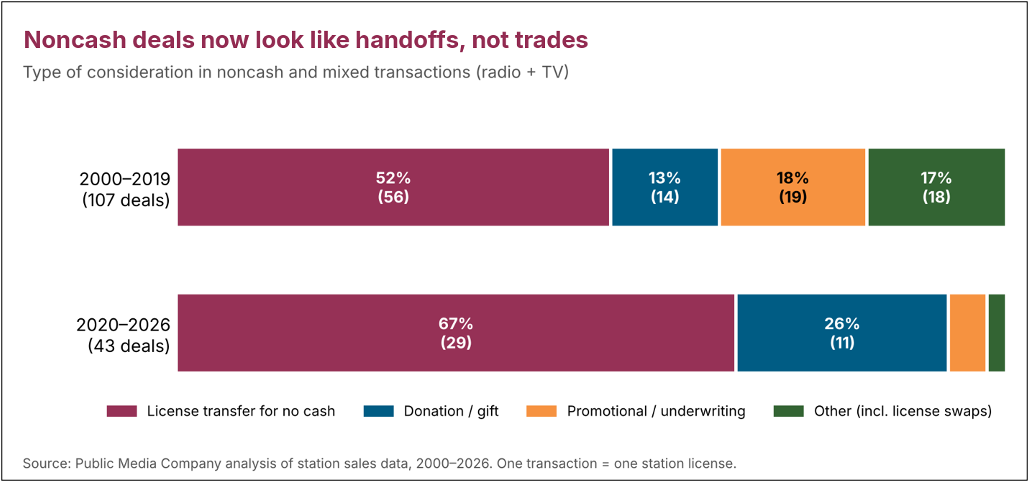
The character of noncash deals has changed, too. Before 2020, noncash deals often looked like trades: The buyer paid in on-air underwriting, license swaps, or other in-kind value. Only 65% of noncash and mixed deals were straight license transfers, donations, or gifts. Since 2020, that figure has climbed to 93%. In other words, these are increasingly handoffs rather than exchanges of value.
A Note on How We Counted
Our data counts each station license as its own transaction, so a single multi-station deal can move the numbers significantly. Counting each deal once, regardless of how many stations it covered, the share of no-cash deals still rose, from 28% to 42%.
Why It's Happening
Two factors are driving the trend.
-
A move toward trusted successors. Institutions are moving away from open, highest-bidder cash sales toward negotiated transfers to a trusted successor, often a local public media organization, an affiliated school or university, or a donation meant to keep a signal on the air as a local public media asset rather than let it go dark or go to a religious network. Outside of public broadcasters, institutional licensees' main alternative has been to sell to a noncommercial religious network such as Educational Media Foundation (EMF), American Family Radio, or Bott Radio Network. EMF in particular has been the most aggressive buyer of commercial and noncommercial stations across the country.
-
Too many stations, not enough buyers. Radio and TV station prices have trended downward since the COVID-19 pandemic in 2020. Several factors have softened demand for broadcast licenses, including the migration of audiences and revenue to digital platforms and the lower revenue and margins that digital services generate. Public broadcasters now also face a more uncertain future after losing more than $500 million in federal funding, along with a political landscape that has a number of states cutting back funding. Educational institutions are facing political pressure, too, with universities teetering on the edge of an “enrollment cliff.” All of this is putting more licenses in play. The cash deals that do still happen reflect this softer market. The median all-cash institutional licensee transaction fell from about $250,000 before 2020 to about $95,000 since.
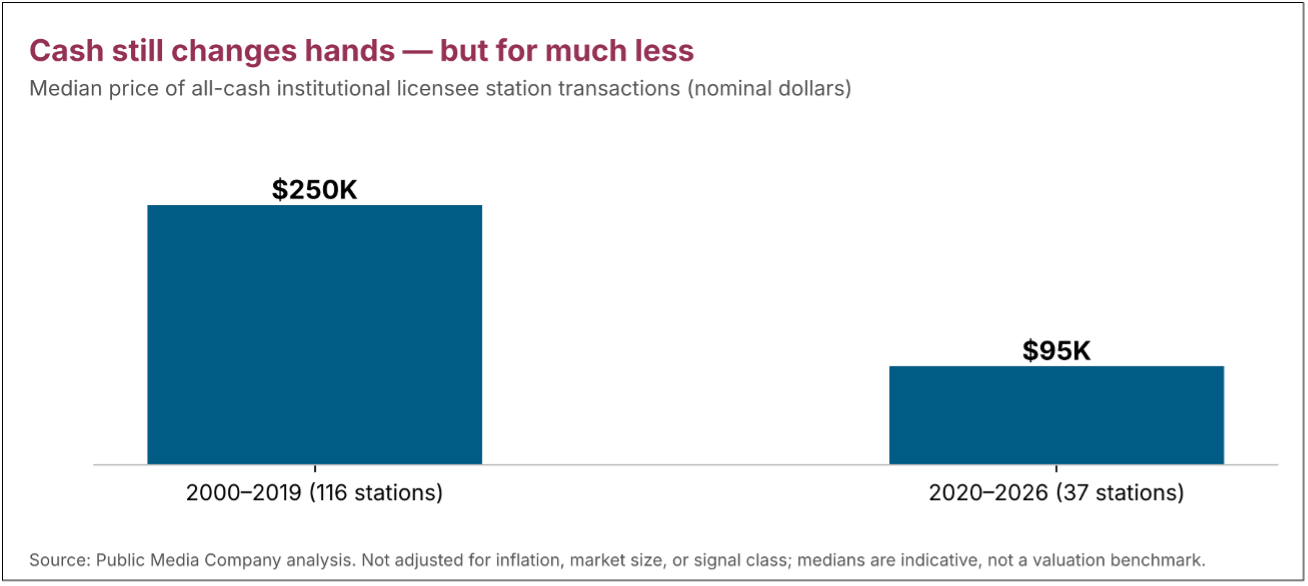
Note: These medians aren't adjusted for inflation, market size, or signal class, so they are indicative of direction rather than a valuation benchmark. Adjusting for inflation would widen the gap.
Looking Ahead
The macroeconomic conditions of the post-COVID era, persistently high inflation, and the Federal Reserve's tighter monetary policy hurt radio stations, particularly highly leveraged broadcast groups. Interest rates remain high, broadcast audiences continue to decline, and digital growth has not been strong enough to make up the difference. Public broadcasting faces its own challenges on top of that, including the loss of federal funding and state budget cuts.
As a result, the market structure is broken. We expect continued volatility in 2027: more listings, fewer buyers, and declining prices – as well as more noncash transactions between institutional licensees and local nonprofits.
What This Means for Institutional Licensees
For a university, school system, or government body weighing the future of its station, the recent transactions point to a few practical lessons:
-
Define the outcome before the price. In many recent deals, the institution's real goal has been keeping local service under trusted ownership. That means agreeing internally on what success looks like – continued local service, the station's name and call letters, staff, student opportunities – before going to market.
-
Value doesn't have to be cash. Licensees are thinking broadly about what a successor can offer: on-air announcements or underwriting, student internships, commitments to keep operating the station, preserving the name and call letters.
-
Know your realistic buyer pool. Outside public media, the buyer pool is thin and made up largely of religious networks. Licensees should test interest from mission-aligned organizations early and understand what a sale to a non-public broadcaster would mean for their communities and stakeholders.
-
Focus on transition funding: Buyers are increasingly asking the seller to fund the transition, and donors can sometimes fill that gap
-
Write durability into the agreement. Recent deals include minimum operating periods, commitments to keep the station's name and call letters, and opportunities for existing staff. These terms protect the institution's reputation and the community's service.
-
Plan for stakeholders and timeline. Board or regent approval, FCC review, and public reaction all take time.
-
Get an independent valuation, even for a noncash deal. A valuation helps boards meet their fiduciary duties, compare offers that mix cash and in-kind value, and document what the institution gives or receives.
If an institution is weighing options for its license, Public Media Company can help think through the alternatives.
About this Analysis
Public Media Company analyzed radio and full-power TV station transactions from 2000 through mid-2026 in which a university, public school system, or government body was the buyer or seller. Religious and private institutions trading among themselves were excluded. Deal structure was classified as cash, mixed, or noncash based on reported price and transaction notes.