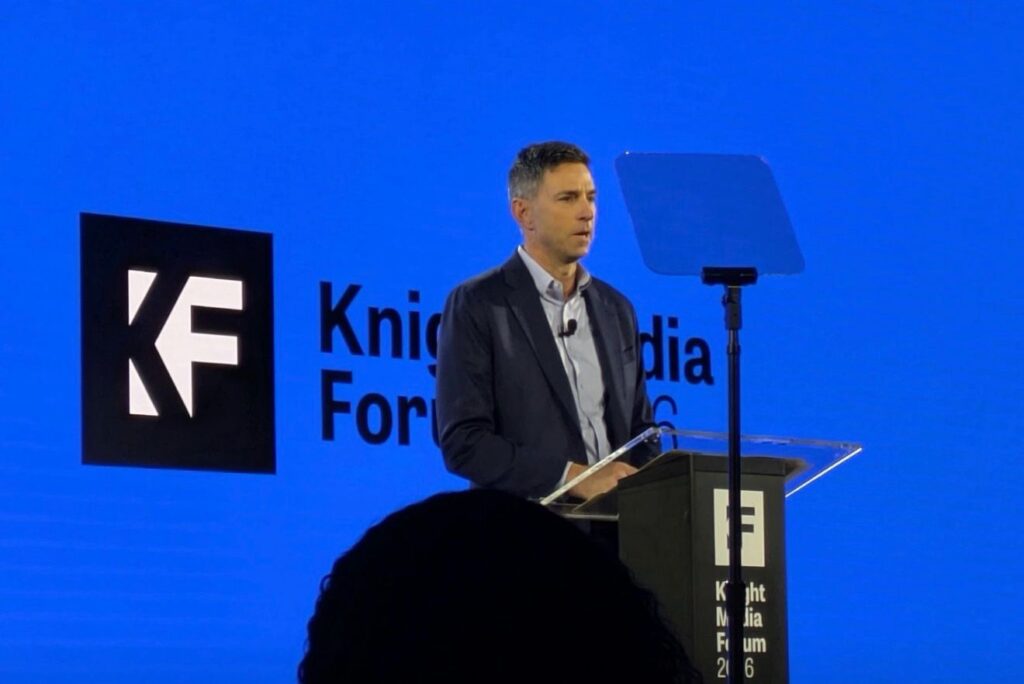
The following remarks were delivered by Public Media Company CEO Tim Isgitt on February 11, 2026, at the Knight Media Forum in Miami, Florida. They have been lightly edited for clarity and readability.
 Good morning everyone. This year Public Media Company is marking 25 years of service to local public and independent media organizations around the country. At PMC, we believe all communities should be connected and enriched by local media. That simple statement is at the core of what we do. It’s the thread throughout our work, and it is why we developed the Public Media Bridge Fund. Today, I’m speaking to you as CEO of PMC, but also as a dad, who – like many of you – is trying to create a better future for my kid.
Last summer, Congress eliminated funding for the Corporation for Public Broadcasting, ending the public support that had underpinned one the great forces in our democratic society for the last 60 years. In the aftermath, all local public media organizations have been destabilized, and that problem is particularly acute for some 115 local organizations that were most reliant on CPB funding. These at-risk organizations are almost all in underserved and rural areas of the country, and most are a rare or the only source of local information. Most are small, but collectively they reach over 40 million Americans.
Let me say that better: Individually they may be small; but collectively they are huge.
As Maribel (Pérez Wadsworth) says, we moved at “the speed of news” to create the Bridge Fund last summer with a number of catalytic funders, many of whom are in this room. By fall, we distributed $26 million to these at-risk stations, and we’ll do more in the spring. In coordination with other efforts, we have temporarily averted a mass shut down that would have jeopardized the entire public media network. Now our focus is shifting to helping stations move from temporary to enduring solutions. In just a moment, Erik Langner, the Executive Director of the Fund, will discuss how we will use this window of opportunity to sustain operations and transform service.
And in the spirit of the Knight Media Forum, I want to talk about a new future for public media – which is really the future of vibrant communities and democracy in America.
Over sixty years ago, FCC chairman Newt Minnow famously described the media landscape as a “vast wasteland.” Making the case for educational television, he argued that commercial companies had no market incentive to produce media that serves the public interest.
Today we live in a totally different world, and the media landscape has changed dramatically. It might be best described now – not as a wasteland – but as a dense and perilous jungle. This jungle is encroaching on us, bombarding us all day long, reducing us to consumers and political pawns, reshaping how we spend our days, manipulating how we relate to one another as humans and neighbors.
This jungle is dominated by trillion-dollar companies. Polarization, division, misinformation, and social isolation are its hallmarks, algorithms and AI are its tools. Within this jungle, the giants drown out the light, too little feeds our curiosity; not enough educates us; and trust is systematically eroded. There is little to no market incentive to connect us as neighbors, to build trust, and prioritize the public interest. And as we all know well, this jungle is growing and morphing fast.
Last year we lost the visionary Jessica Clarke, but I know she is here with us today, challenging us to claim a different future. As she knew well, we need a counterbalance to this jungle, and we need it urgently.
Everyone here has been working to be that counterbalance, some of us for decades. We are all in this together – stations, ethnic media, digital newsrooms, independent filmmakers. When I define “public media” today, I think far beyond traditional definitions. It’s all of us producing independent, community-rooted, and mission aligned media that serves the public interest. We are all public media.
Yet, despite ingenuity and determination of so many, our efforts are simply not keeping up with the speed of change or the scale of need. This is not a criticism, only an acknowledgement of the forces working against us.
So how do we cultivate a publicly supported system that is scaled, fit for purpose and funded for purpose for the next 50 years? Given the dominant role of media in our lives, in our communities, and in our society, that may be the most important question we need to answer for our future.
And let me be clear, in a landscape dominated by trillion-dollar companies, it’s going to take a hell of a lot more than the $535 million provided annually to CPB. A nation that takes democracy seriously must seriously invest in public media.
This may not seem possible in today’s political climate, in this moment, but the truth is we keep seeing things happen that seemed impossible just months ago. It is a question of imagination, boldness, and action. I’ve spent my career at the intersection of media and politics, and I can tell you there is a hunger for stronger, connected communities, across the political spectrum. That’s why we must define the solution now, so that we are ready to help rebuild and reconnect our country when this moment passes. And it will. If public media isn’t at the very top of the rebuild agenda, then we have failed our moment.
In 1967, the Carnegie Commission – informed by the leadership of community leaders from across the country – defined the core principles of the Public Broadcasting Act. Those leaders met their moment and from that wasteland built the future.
Folks, we are in the Carnegie Commission moment of our generation. We have in our hands the agency, opportunity, and even the responsibility to build a new, enduring public media system for the next 50 years. We must meet this moment, and out of today’s media jungle, build our future.
This is at the very heart of Public Media Company’s mission. It is why we created the Bridge Fund. It’s why I’m so grateful to be here at KMF, surrounded by brilliant people who know how to make hard things happen.